Frankfurt Buchmesse 2026, Through Our Team’s Eyes
From 7 to 11 October 2026, the İntrotema team was at the Frankfurter Buchmesse, one of the most important weeks in the publishing calendar and, for us, still the place where you can feel the pulse of the industry.
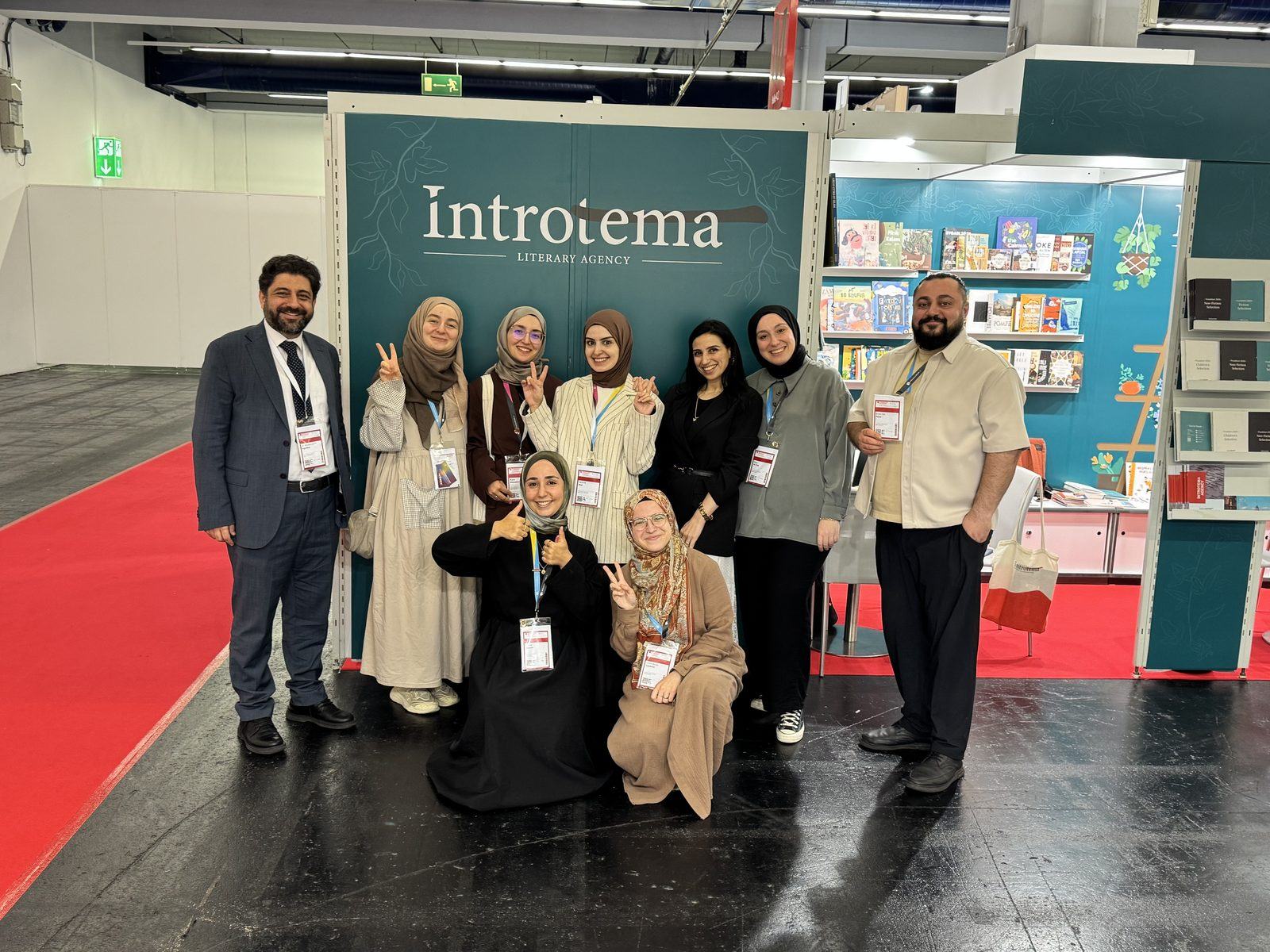
This year we came with a nine-strong team, two tables in Hall 1.2 alongside the world’s literary agencies and our stand in Hall 4.2. Preparations had begun some four months earlier, and from the first pre-booked meeting to the final afternoon the week ran at full pace. We sat down with publishers from as far apart as Mongolia, Korea, Brazil, Uruguay, India and Saudi Arabia, many of them for the first time, while a good number already knew us from our newsletters and came looking for the stand by name. Our translation team drew plenty of interest, and we came home with new translators in our pool.
It was also a Frankfurt in transition. Hall 6 was closed entirely, the familiar layout of the halls was reshuffled, and for the first time the fair opened to the general public on the Friday. The Korean stand was one of the busiest in the building, still packed late on Saturday, while Syria returned with a stand of its own, and our team met the Syrian Ambassador to Germany and the Consul General during the week.
There was plenty to follow up on, too. At the Türkiye stand, the B2B meetings we organised for the TURLA project, which we run on behalf of the Turkish Press and Publishers’ Association, kept the space busy throughout. We sat down with officials from Azerbaijan’s Ministry of Culture to talk about taking Azerbaijani literature abroad, and we will be following closely a new initiative between the Arab Publishers Association and Abu Dhabi to publish a curated catalogue of Arabic titles and fund their translation. At the Türkiye Diyanet Foundation stand, we also met publishers from several countries to introduce the newly founded International Union of Islamic Book Publishers, and were delighted to find publishers from the UK, Indonesia, Malaysia and the Arab world keen to join.
We also asked the people who spent those five days in Frankfurt to tell us how it went. Their answers tell much the same story: busy, colourful and, above all, productive. Here is the week in their own words.
Voices from the fair
Frankfurt is shrinking. The question is whether it is only the fair, or the way our industry does business.
I have been coming to Frankfurt for many years, and it remains the place where you can feel the pulse of world publishing. But I left this year with more questions than usual. Closing Hall 6 might look like a simple organisational decision, yet I think it has to be read alongside the wider economic pressures on our industry. Taking part in an international fair is no longer just the cost of a stand: travel, accommodation, staff, design and logistics add up to a serious budget, especially for small and medium-sized publishers.
Digital tools mean you no longer have to be at a fair to discuss rights or meet a new partner. Even so, I still believe nothing replaces sitting across the table from someone when it comes to building trust and long-term partnerships. And despite our concerns about the bigger picture, it was a very full and productive fair for İntrotema. The feedback from our colleagues at the agency tables was especially positive.
To me, success at an international fair is no longer measured simply by being there. It depends on the quality of the preparation beforehand, how well the meetings are planned, and how effectively you follow up afterwards. Our aim has always been to bring the authors and publishers we represent to as many readers, in as many places, as possible, and that is how we look at Frankfurt: not just as a week of rights sales, but as a chance to widen our international network.
One thing that stayed with me was how much space English language teaching takes up compared with every other language. A language does not travel only because of how many people speak it, but because of the education and publishing industry built around it. That is something I would love to see grow for languages like Turkish and Arabic. Frankfurt is changing as the industry changes. The question now is whether we, as a sector, can change with it.
Frankfurt has turned into a selling fair.
This year I was at our agency table rather than on the stand, and it felt less like a trade fair and more like a fellowship. Nearly all my meetings were with publishers from Latin America, the wider Spanish-speaking world, the Nordic countries and China, and it brought home just how much real potential we have in those markets. Pick a region, build proper relationships there, and you can take their books out to the world while bringing ours to them.
Frankfurt was always said to be a fair for meeting people and nurturing relationships rather than doing deals. I think that has changed. People are shaking hands at the table now, and they genuinely love the books, so we will see the results over the coming months. From a rights point of view, it was the best fair I have ever done.
“We know you from your newsletters.”
It was a lovely fair, and a really productive one. We met a lot of publishers for the first time, and several walked up saying they already knew us from our newsletters and emails. From Mongolia, China and Korea to Germany and Saudi Arabia, we got our books in front of people we had never worked with before.
Everyone loved the stand and the little gifts we had made, and plenty of people walked off with the catalogues from our translation team. A few even asked if they could keep a copy of one of our books in the original language, despite not being able to read a word of it. It was my first Frankfurt: hectic, great fun, and packed with people discovering our list.
Opening doors for books in both directions.
Frankfurt was a very productive fair for me this year. I spent the days moving between meetings with German and international publishers and our own busy agency stand. What I value most about Frankfurt is the opportunity to open doors for books in both directions, introducing German titles to publishers abroad while bringing international titles to the German-speaking market.
It was great to see such a wide range of titles and publishing interests represented in our meetings, reflecting the diversity of our agency’s work. The new fair structure brought a few challenges to get used to, but it also reminded us that Frankfurt continues to evolve and offer new opportunities for everyone.
People came looking for us by name.
It was a genuinely productive fair for İntrotema, with new partnerships and new markets opening up. I spent most of my time on the stand, and a surprising number of visitors told us they had been hunting for us all week, some having searched for us by name.
We lost count of how often we heard, “Oh, İntrotema! I get your emails every day.” It was a nice reminder of just how far our newsletters reach, long after the fair is over.
So many cultures under one roof.
Discovering new books from so many cultures and meeting so many new people was a real joy. It was a vibrant fair, with back-to-back meetings. Having people, books and cultures from so many countries under one roof, and hearing how readers abroad respond to the books we represent, made it very special for us.
We also met translators working across a whole range of languages and added several new names to our translator pool.